

Emergency Medicine Simulation
Fellowship Overview
Overview
The Emergency Medicine Simulation Fellowship at Eisenhower Health is a 12-month advanced training program designed to cultivate leaders in medical education, simulation based learning, and healthcare quality improvement. Fellows will gain expertise in high fidelity simulation, procedural training, curriculum design, and faculty development while contributing to the advancement of simulation education.
Program Length: One year
Salary: Base salary of $125,000 with internal moonlighting opportunities at competitive rates for clinical shifts above the base.
Shifts: Eight 10-hour clinical shifts per month as the attending in the Emergency Department
Education: Certificate in Simulation Education and Faculty Development through leading simulation organizations
Program Highlights
A fellowship built for the next generation of simulation educators
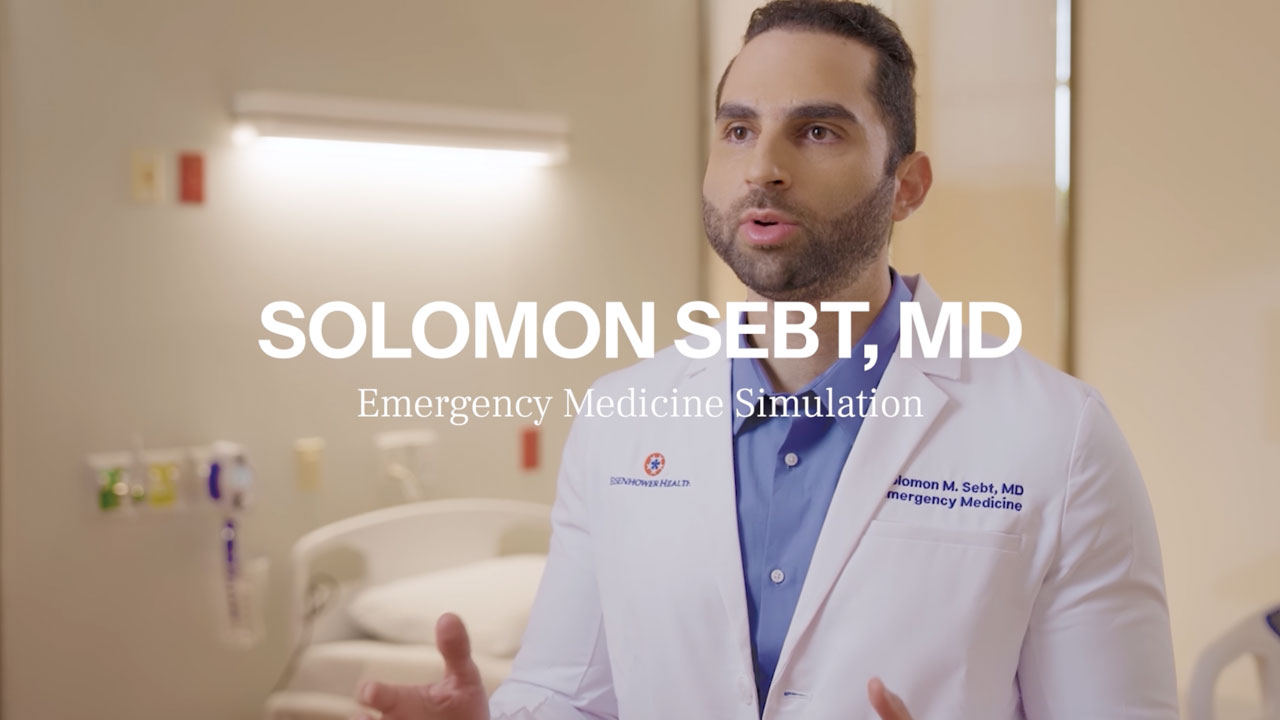
The Eisenhower Health Emergency Medicine Simulation Fellowship is a 12-month, post-residency training program that prepares board-eligible/board-certified emergency physicians to design, lead, and evaluate simulation-based education at every level — from medical students to attending faculty, and out into the wider community of paramedics and EMS partners we train. Because the program was built from the ground up by its founder, fellows inherit not just a curriculum but the complete operational playbook for starting a simulation center and a fellowship of their own. Fellows graduate with a capstone project, a scholarly product, a Certificate in Simulation Education and Faculty Development, and rare hands-on program-building experience.
Learn to Build a Sim Center
Dr. Sebt built Eisenhower's simulation center and this fellowship from the ground up. Fellows inherit the complete playbook — plan, fund, equip, staff, launch.
Clinical Excellence
Eight 10-hour shifts per month in our high-acuity Tennity Emergency Department, included in the base salary with optional moonlighting on top.
Protected Scholarly Time
Dedicated research blocks, mentorship for publication, and a capstone project that extends the existing curriculum.
Hands-on Operations
Learn the business of simulation: AV systems, manikin programming, debriefing frameworks, scenario authoring, and budgeting.
Mission-driven Mentorship
Weekly 1:1 with the program founder, structured feedback after every debriefing, and a graduated path from co-debriefer to lead educator.
Community & EMS Partnerships
The Stauffer Center trains paramedics, EMS agencies, and regional partners. Fellows lead and grow these off-campus relationships.
Teaching Across Specialties
Lead sessions across critical care, emergency medicine, NICU/OB, and interprofessional code teams — plus our community and EMS partners.
National Network
Conference travel funded for IMSH, SimGHOSTS, ACEP, SAEM, and the Society for Simulation in Healthcare. Fellows present at least once nationally.
Curriculum Structure
A longitudinal, 12-month curriculum spanning clinical practice, simulation education, research, and leadership. Each fellow's experience is shaped to their interests and career goals — but every fellow leaves with the same seven foundational components.
Clinical Practice
Maintain clinical excellence with shifts in Eisenhower's state-of-the-art Emergency Department.
Simulation Education
Weekly simulation sessions and faculty meetings, with opportunities to lead scenarios and workshops.
Innovations in Simulation
Explore and utilize AR/VR and other advanced innovative and simulation technologies.
Quality Improvement & Administrative Milestones
Engage in formal QI work and gain hands-on exposure to the operational side of running a simulation program.
Present QI Project Progress
Refine simulation curriculum and complete general simulation program administrative training.
Research
Complete a scholarly project related to simulation or quality improvement, with dedicated support for mentorship and publication.
Attend National Conferences
Such as IMSH or SAEM Simulation Academy, with funding for educational activities.
Seven Pillars of the Program
Across the year, fellows develop expertise in seven domains that prepare them to lead a simulation program of their own.
Simulation-Based Training
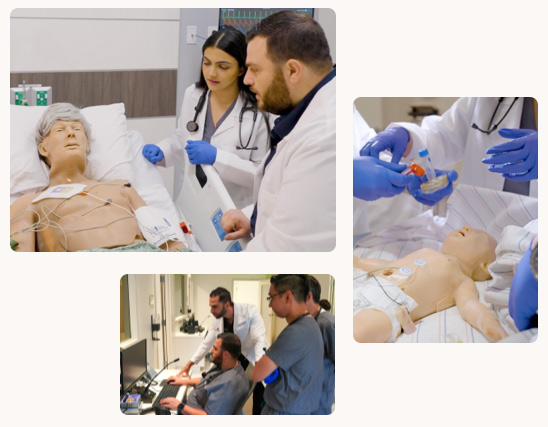
Hands-on training using high-fidelity manikins and immersive scenarios to build clinical decision-making, technical skills, and team performance.
Quality Improvement and Patient Safety
Use simulation to identify latent safety threats, test system changes, and measurably improve real-world patient care.
Professional Development
Build the skills to lead a simulation program — speaking, teaching, mentoring, and presenting nationally as a clinician-educator.
Technology-Assisted Healthcare
Explore how emerging technologies are reshaping clinical practice — and how simulation prepares clinicians to adopt them safely.
Curriculum Design and Education
Adult-learning theory, scenario authoring, learning objectives, and assessment rubrics to deliver simulation curricula across specialties.
Research and Scholarship
Peer-reviewed scholarly project with mentorship from program leadership and support for statistical analysis, writing, and publication.
Integration of Simulations With Innovations
Combine simulation with AR/VR, AI-conversational manikins, and screen-based virtual patients.
The Simulation Center
John Stauffer Center for Simulation and Innovative Learning
A 2,500-square-foot simulation facility in the newly transformed Annenberg Health Sciences Building — built from the ground up under Dr. Sebt's leadership. The Stauffer Center features four fully-equipped clinical environments — ED, ICU, OBGYN/NICU, and medical/surgical — outfitted with Gaumard's most advanced patient simulators. Manikins respond to voice commands, sweat, bleed, cry, urinate, and use real-time AI to hold genuine conversations with learners. The center serves the entire Eisenhower Health system plus our community partners — including local paramedics, EMS agencies, and other regional providers we train regularly.
Leadership & Faculty
Solomon Sebt, MD
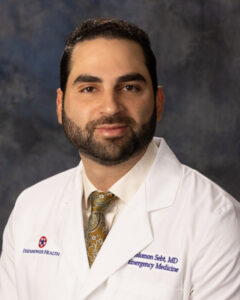
Dr. Solomon was born in Jackson, Mississippi, but was raised in Lawrence, Kansas. He earned his bachelor’s degree in Exercise Physiology with the highest distinction from the University of California at Davis. Subsequently, he attained his Medical Degree (MD) with Summa Cum Laude honors from St. George’s University, where he was also a member of the Gold Humanitarian Honor Society.
Following his academic achievements, Dr. Solomon pursued his residency training in emergency medicine at Eisenhower Medical Center, where he ascended to the role of Simulation Chief Resident. Notably, his involvement in the simulation committee was instrumental in the establishment of Eisenhower’s inaugural simulation center in 2022. During his tenure as Chief Resident, he further honed his skills through mentorship in simulation by Fellowship Director Dr. Eric McCoy at the University of California, Irvine.
Presently, Dr. Solomon is a board certified attending physician and core faculty member within our emergency residency program*. Moreover, he holds the esteemed position of Medical Director at the John Stauffer Center for Simulation and Innovative Learning, demonstrating his commitment to advancing medical education and practice
*Board Certified in Emergency Medicine
Program Director’s Message
Welcome, and thank you for your interest in our Simulation Fellowship Program.
This is more than a traditional fellowship—it's a launchpad for future leaders in medical education, innovation, and systems improvement.
What sets our program apart is the depth of experience we offer, grounded in real institutional impact. I had the privilege of helping design and launch our hospital’s very first simulation center—from concept to construction to curriculum. That journey taught me how to build something meaningful from the ground up, and it’s this knowledge I’m excited to pass on to our fellows.
Fellows in our program are immersed in every dimension of simulation leadership: they participate in root cause analyses, transform quality gaps into targeted simulations, and teach across multiple disciplines including EM, OB/GYN, surgery, and nursing. We also offer access to advanced technologies like VR, AR, robotics, and AI—resources rarely found at most centers.
You’ll contribute to research including national projects like PECARN, IRB backed research projects and gain real experience in strategic planning, interdepartmental collaboration, and institutional decision-making. If you’re passionate about healthcare education and eager to make a lasting impact, our fellowship will prepare you to not only lead a simulation center—but to build one.
We’re excited to support the next generation of simulation leaders.
Warm regards,
Solomon Sebt, MD
Program Director, Simulation Fellowship
Eisenhower Health Medical Center
Have Questions About Our Programs or Need Help?
Contact us to learn more about Eisenhower Health's Graduate Education programs.